Understanding how drones work involves a fascinating journey through mechanical engineering, advanced electronics, and intelligent software. The video above provides an excellent visual introduction to the core components and principles that enable these remarkable flying machines. Here, we’ll delve deeper into these concepts, expanding on the intricacies that allow drones to perform complex maneuvers and maintain impressive stability.
Unveiling Drone Design: From Single Propeller to Quadcopter Dominance
The evolution of drone design showcases a clear path towards achieving optimal control and efficiency. Early prototypes, such as a single-propeller drone, illustrate fundamental aerodynamic principles, yet they present significant challenges. While a single propeller generates sufficient lift for vertical movement, controlling its direction and preventing unwanted body rotation due to Newton’s Third Law of Motion remains problematic.
Newton’s Third Law states that for every action, there is an equal and opposite reaction. In a single-propeller setup, the motor imparts torque to the propeller, causing it to spin. Consequently, the propeller exerts an equal and opposite reaction torque on the motor’s stator, which is fixed to the drone’s body. This reaction torque would cause the entire drone body to spin uncontrollably in the opposite direction of the propeller, rendering it practically unusable for directed flight.
The concept of a two-propeller drone, as explored by companies like ZeroZero Robotics, offers a more elegant solution to this rotational issue. By having two propellers rotate in opposite directions, the reaction torques from each motor effectively cancel each other out. This design significantly reduces unwanted body spin, leading to better stability and potentially lower energy consumption for longer flight times.
However, achieving high-speed flight and sharp, quick turns with just two propellers demands incredibly precise control algorithms. The fewer the propellers, the greater the reliance on sophisticated software to manage stability and maneuverability. While two-propeller designs promise efficiency, the current state of control algorithms often favors more robust configurations for demanding applications.
Three-propeller designs are rarely seen in the drone market due to inherent complexities. These configurations struggle with balancing reaction torques and gyroscopic precession, leading to unnecessary design and algorithmic complications. The sweet spot for stability, control, and performance for most applications clearly lies with the quadcopter, featuring four propellers.
Mastering the Skies: How Quadcopters Maneuver
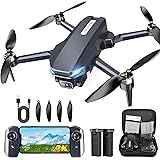
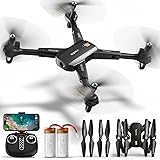
Quadcopter drones, whether in an H-shape or X-shape configuration, dominate the market due to their superior stability and control. Their ability to perform precise maneuvers like hovering, forward motion, roll, and yaw stems from the intelligent manipulation of individual propeller speeds and rotational directions. The propellers themselves are marvels of engineering, utilizing an airfoil shape to generate lift force efficiently.
To achieve hovering, the flight controller ensures that the total thrust generated by all four propellers precisely balances the drone’s weight. This delicate equilibrium allows the drone to remain suspended in the air. For forward motion, the front propellers slightly decrease speed while the rear propellers accelerate. This creates a pitch motion, tilting the drone forward, and an unbalanced horizontal force that propels it in the desired direction.
Similarly, a drone’s roll movement is initiated by creating an imbalance in lift forces between the left and right pairs of propellers. For instance, increasing the speed of the left propellers and decreasing the speed of the right propellers will cause the drone to roll to the right. This precise control over differential thrust is crucial for agile movement.
Yaw motion, which involves the drone spinning on its vertical axis, is achieved through a particularly ingenious method in quadcopters. To counteract the unwanted reaction torque from Newton’s Third Law, quadcopters are designed with one diagonal pair of propellers spinning clockwise and the other diagonal pair spinning counter-clockwise. This setup ensures that the reaction torques cancel each other out, preventing accidental yaw during normal flight.
When an operator desires to yaw the drone, the flight controller subtly adjusts the speed of one diagonal pair relative to the other. For example, reducing the speed of the clockwise-spinning propellers would decrease their reaction torque, creating a net uncancelled reaction torque from the counter-clockwise pair. This intentional imbalance then causes the drone to yaw in the desired direction, demonstrating a sophisticated application of fundamental physics.
The Brains Behind the Flight: Drone Controllers and Sensors
Even with advanced mechanical designs, human reaction time is simply insufficient to control a drone effectively in dynamic environments. Imagine a sudden gust of wind hitting a drone; an operator would need to readjust multiple propeller speeds and rotation directions in milliseconds to prevent a crash. This is where the drone’s “brain”—the flight controller—becomes indispensable.
The flight controller acts as a tiny, intelligent pilot, continuously processing data and making instantaneous decisions. It translates the operator’s simple commands (like “up,” “forward,” or “yaw”) into precise motor adjustments, making drone operation feel as intuitive as playing a video game. This remarkable capability is only possible with a constant stream of highly accurate input signals from various drone sensors.
The Interesting World of Drone Sensors and MEMS Technology
Modern drones incorporate an array of incredibly tiny yet highly accurate sensors, many of which are comparable in size to an ant. The miniaturization and precision of these components are largely thanks to MEMS (Micro-Electro-Mechanical Systems) technology. MEMS sensors are microscopic machines that integrate mechanical elements, sensors, actuators, and electronics on a common substrate, often silicon, allowing for complex functionality in a compact package.
At the heart of drone sensing is the IMU (Inertial Measurement Unit), a critical component that combines three vital sensors: accelerometers, gyroscopic sensors, and magnetometers. The IMU is the “king of drone sensors” because it provides fundamental data about the drone’s movement and orientation in three-dimensional space.
Accelerometers measure the drone’s linear acceleration along three axes. In a typical MEMS accelerometer, as the drone experiences force, tiny plates within the sensor move relative to each other. This movement changes the capacitance between the plates, which is then converted into electrical signals for the flight controller to interpret. Gyroscopes, on the other hand, measure the angular velocity or rotational changes around three axes, providing crucial data for maintaining stability and executing turns. Magnetometers function as digital compasses, detecting the Earth’s magnetic field to help the drone determine its heading and orientation.
Beyond the IMU, other essential sensors contribute to a drone’s situational awareness. A MEMS-based barometer sensor accurately determines the drone’s altitude by measuring atmospheric pressure. This data is critical for maintaining stable height and performing precise vertical maneuvers. Together, these tiny sensors paint a comprehensive picture of the drone’s position, movement, and orientation.
Advanced Control Algorithms and Sensor Fusion for Unrivaled Stability
The raw signals from sensors, while crucial, are susceptible to noise and interference. Mechanical vibrations from the propellers, magnetic interference, and inherent sensor defects can compromise accuracy. To overcome these challenges, modern drones employ sophisticated techniques like sensor fusion and advanced control algorithms.
Sensor fusion is the process of combining data from multiple sensors to achieve a more accurate and reliable measurement than any single sensor could provide. For instance, a GPS sensor can offer basic altitude information, but integrating this with data from the IMU and even radar technology can create a super-accurate altitude reading. By intelligently cross-referencing and validating data points, sensor fusion significantly enhances the drone’s perception of its environment, reducing errors and improving overall system reliability.
With accurate sensor data in hand, the flight controller moves to the decision-making phase, guided by its control system and embedded algorithms. One of the most prominent and powerful algorithms used in drone technology is the Kalman Filter (KF). The Kalman Filter is an optimal estimation algorithm that uses a series of measurements observed over time, containing noise and other inaccuracies, and produces estimates of unknown variables that tend to be more precise than those based on a single measurement alone.
The KF algorithm is instrumental in predicting the drone’s future state by analyzing past and present data. It effectively filters out noise, making the sensor signals cleaner and more reliable. This predictive capability is vital for GPS navigation, enabling features like “return to home,” and most importantly, stabilizing the drone after external disturbances, such as unexpected wind gusts. The Kalman Filter processes data and instructs the BLDC (Brushless DC) motors to adjust their speeds precisely, allowing the quadcopter to maintain stability and execute commands seamlessly even in challenging environments.
Powering Flight and Communication: The Backbone of Drone Operations
All the sophisticated mechanics, sensors, and algorithms in a drone rely on a consistent and powerful energy source. Lithium-ion batteries are the industry standard for consumer and many professional drones due to their high energy density and relatively low weight. These batteries supply the necessary power to the BLDC motors, electronic circuits, sensors, and communication systems, ensuring sustained flight and operation.
Communication between the drone and its operator typically occurs via radio frequency (RF) technology. For consumer drones, this communication range can extend between one to two kilometers. This range is sufficient for most recreational flying, but beyond it, the drone risks losing contact with the controller. To mitigate the risk of a lost drone, modern systems incorporate advanced safety features.
One such critical feature is the “return to home” function. Before launching, operators usually set a home location using GPS. If the drone accidentally flies out of communication range or experiences low battery, it can autonomously use its onboard GPS and, in some cases, tower-based internet technology, to navigate itself safely back to the predetermined home location. This autonomous capability highlights the sophisticated integration of multiple technologies to ensure user experience and safety.
Industry Leaders and Future Innovations in Drone Technology
The drone market is competitive, with companies constantly pushing the boundaries of technology. DJI, for instance, has emerged as a leading force in the consumer drone market, largely due to its commitment to refinement and innovation. Their drones often feature advanced flight control algorithms, dual IMUs for enhanced reliability and redundancy, and sophisticated vibration dampening systems. These innovations collectively reduce sensor errors and improve flight stability, resulting in a superior user experience and higher performance.
While competitors like Parrot, Autel, and Yuneec offer commendable products, DJI’s consistent investment in research and development has often given them an edge in terms of market share and perceived quality. The emphasis on robust algorithms and hardware-software integration is a clear differentiator, showcasing how even subtle refinements in components like IMUs and vibration management can lead to significant improvements in drone operation.
The continuous advancements in drone technology, from propeller design to advanced algorithms, mean that these flying machines are becoming increasingly capable and accessible. The sophisticated interplay of hardware and software ensures that how drones work will only continue to evolve, unlocking new possibilities across countless industries.
Unmanned Answers: Your Drone Q&A
How do drones manage to fly and stay stable in the air?
Drones combine mechanical design, advanced electronics, and intelligent software to fly. These elements work together to allow them to perform complex movements and remain stable.
Why do many drones, especially quadcopters, have four propellers?
Quadcopter drones typically have four propellers because this design offers superior stability, control, and performance. This configuration helps balance reaction torques and allows for precise maneuvering.
What is a flight controller and what does it do in a drone?
The flight controller acts as the drone’s ‘brain,’ processing data from sensors and making instantaneous decisions. It translates the operator’s simple commands into precise motor adjustments to control the drone.
What are some key sensors that help a drone understand its position and movement?
Drones use an Inertial Measurement Unit (IMU), which includes accelerometers, gyroscopes, and magnetometers, to track movement and orientation. A barometer sensor also helps determine the drone’s altitude.